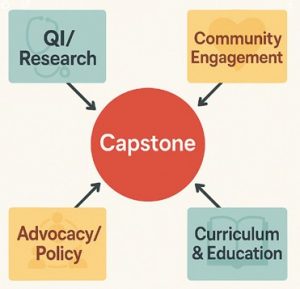
The HDT Capstone is a longitudinal project completed over the course of the track with dedicated mentor support. The capstone is designed to allow participants to apply core concepts from the curriculum to a meaningful, real-world initiative that advances health equity within clinical, community, educational, or policy settings.
Participants select a capstone focus area aligned with their interests and career goals. Capstone projects fall into one or more of the following domains:
- Quality Improvement and Research
- Community Engagement
- Advocacy and Policy
- Curriculum and Education
Learners are paired with faculty and community mentors who provide guidance throughout project development, implementation, and dissemination. The longitudinal structure allows participants to move beyond short-term interventions and instead engage in sustained, iterative work that reflects the complexity of addressing health disparities.
Capstone projects are expected to be grounded in real-world contexts and, when possible, connected to local or regional needs. Many projects leverage existing partnerships within Hartford and surrounding communities, reinforcing the HDT emphasis on place-based learning and community collaboration.
By the end of the track, participants produce a tangible scholarly or applied product, such as a quality improvement initiative, educational curriculum, community partnership deliverable, advocacy effort, or research project. The capstone serves as a culminating experience that integrates knowledge, leadership skills, and systems thinking developed throughout the HDT.