Month: April 2026

Dr. Angela Bermúdez‑Milán Leads Community‑Driven Research to Nutrition Access

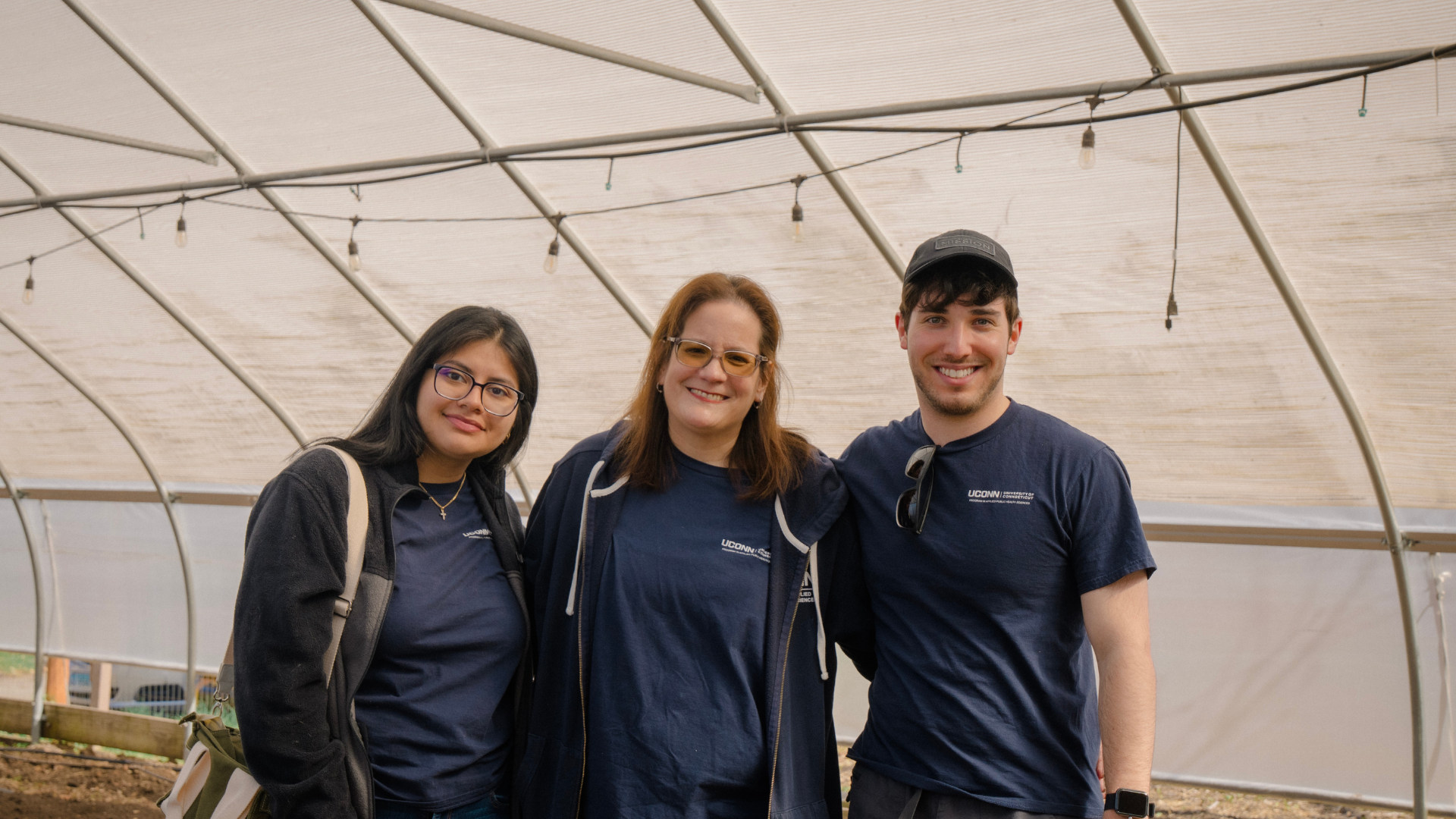
Angela Bermudez, Michael Raizin, and Lisbeth Moran with the greenhouse at Keney Park

Public Health Nutrition students at UConn Health are gaining hands‑on, community‑centered experience thanks to Dr. Angela Bermúdez‑Milán’s innovative approach to teaching public health practice. Through a partnership with the Keney Park Sustainability Project and local health programs, students are applying classroom learning directly to real community needs.

In her Public Health Nutrition course, Dr. Bermúdez‑Milán integrates public health practice, program evaluation, and community engagement. MPH students—including Lisbeth Moran and Michael Raizin—spent time at the Keney Park garden learning about hydroponics, urban farming, and the food hub program. Their work extended beyond observation: students collaborated with program leaders to evaluate existing recommendations from previous consultants and helped strategize how to put those recommendations into action.

During National Public Health Week, Dr. Bermúdez‑Milán also presented findings from a community‑based participatory pilot study conducted with the Hartford Women, Infants, and Children (WIC) program at Keney Sustainability Park. The study, Barriers to Farmers Market Voucher Redemption among Hartford WIC Participants, aims to strengthen WIC benefit use and inform future childhood obesity interventions. This work was supported through a collaboration between the UConn Health Department of Public Health Sciences and the ICR/Community Research Alliance (CRA), funded by the Health Net, Inc. Chair in the Department of Public Health Sciences.

Angela Bermudez, Michael Raizin, and Lisbeth Moran speaking with Herb at Keney Park

The partnership continues to grow. Herb Virgo, Director of the Keney Park Sustainability Project, is exploring new ways to bring fresh produce and nutrition education directly to Hartford communities. Plans include cooking demonstrations using garden-grown vegetables and a repurposed mobile bus that will deliver fresh produce to neighborhoods with limited grocery access.

Students play an active role in these initiatives, gaining first‑hand experience in collaborative public health practice, community engagement, and program implementation. This partnership exemplifies how applied learning can prepare future public health professionals to address real‑world challenges with creativity, cultural humility, and community partnership.

For more information, contact Dr. Angela Bermúdez‑Milán at bermudez-millan@uchc.edu.

To learn more about the Keney Park Sustainability Project, visit: https://keneyparksustainability.org/

CPES Research Highlighted by Pew: Promoting Public Health via Cross-Sector Data Sharing

CPES Research News

We’re proud to share that research and expertise from the Center for Prevention Evaluation and Statistics (CPES) at UConn Health, led by Dr. Megan O’Grady, were featured in a recent article published by The Pew Charitable Trusts, highlighting Connecticut’s leadership in cross-sector data sharing to strengthen public health policy and practice.

The Pew article, “Improving Connecticut’s Public Health Through Cross-Sector Data-Sharing,” examines how Connecticut is using collaborative, cross-agency data efforts to inform prevention strategies and improve health outcomes statewide. Central to this work is the State Epidemiological Outcomes Workgroup (SEOW) Prevention Data Portal, a resource developed through partnerships among the Connecticut Department of Mental Health and Addiction Services (DMHAS), CPES at UConn Health, and the Connecticut Data Collaborative.

CPES plays a key role in supporting and managing the Prevention Data Portal, which brings together local, state, and federal data sources to make complex public health information accessible and actionable. The portal provides free, publicly available products—including epidemiological profiles, data stories, and infographics—covering topics such as substance use, mental health, suicide, and other critical public health issues affecting communities across Connecticut.

As Pew notes, Connecticut’s experience demonstrates how strong leadership, cross-sector partnerships, and practical use cases can help overcome common barriers to data sharing—without requiring major new investments in infrastructure. The lessons highlighted in the article offer a roadmap for other states seeking to use data more effectively to guide prevention, promote health equity, and inform policy decisions.

This national recognition underscores CPES’s ongoing commitment to data-driven prevention and collaboration in service of healthier communities. We invite you to read the full Pew article to learn more about how Connecticut’s approach to cross-sector data sharing is making an impact—and how CPES research continues to support this important work.

Read the Pew article:
Improving Connecticut’s Public Health Through Cross-Sector Data-Sharing